
Goat Fencing
Disclosure: we may earn a commission when you buy through some links on this page, at no extra cost to you. It does not affect what we recommend or how we rank it. How this works.
There is an old line that if a fence will not hold water it will not hold a goat. It is a joke, but it points at something real. Goats climb, lean, rub and push in a way other stock does not.
The short version
- Woven wire for the boundary. Sheep and goat spacing, not field fence.
- Skip welded wire. The welds break when a goat leans, and goats lean.
- Electric: three strands minimum, three to five preferred, lowest wire close to the ground.
- Mesh size stops head-sticking. Big squares plus horns is a bad combination.
- A fence is a layer, not a wall. Predators are a separate job.
Woven wire, welded wire, electric
| Woven wire | Welded wire | Electric | |
|---|---|---|---|
| Joints | Wrapped, flexes and returns | Welded, snaps under load | None to break |
| Goats leaning | Holds | Fails at the welds | They learn not to |
| Moves easily | No | No | Yes, that is the point |
| Needs power | No | No | Yes, and grounding |
| Cost up front | High | Medium | Low to medium |
Most people who keep goats for a few years end up with both. Woven wire on the outside so a failure does not put animals on a road, and electric inside for moving them around.
Mesh spacing, and the stuck head
Woven wire is horizontal wires held apart by vertical ones called stays. The gap between wires is what you are buying. UGA Extension describes the spacing varying with the animal: tighter for smaller stock, wider for bigger.
Buy fence made for sheep and goats. Field fence and cattle panel have squares big enough for a goat to push its head through. Going forward is easy. Coming back, the horns catch.
People treat this as a nuisance. It is worse than that. A goat stuck in a fence in July, in full sun, with no water, is in serious trouble within hours.
Electric fence for goats
An electric fence does not hold an animal back. It teaches one. That difference decides how you build it and what happens when it fails.
Extension guidance for small ruminants calls for three strands at a minimum, and prefers three to five, with the lowest wire close to the ground. Alabama Extension describes polywire strands reaching close to the ground for sheep and goats, and notes that netting for small ruminants uses struts about every 12 inches with posts about every 12.5 feet.
The low wire is the one people leave off, and it is the one that matters. A goat goes under before it goes over.
An unpowered electric fence is not a fence
Woven wire fails slowly and visibly. Electric fails silently, in a way you cannot see from the house. Goats find out before you do, and once they learn a wire is dead they stop respecting it even after it is fixed. Sizing the energizer and grounding it properly is covered in the energizer and grounding guide.
Keeping goats in is not keeping predators out
These are two jobs and one fence rarely does both well. Containment asks a fence to stop an animal pushing out. Predator exclusion asks it to stop something digging under, climbing over, or squeezing through.
For predator protection specifically, eXtension describes night penning areas built with 6 to 8 foot fencing using 4 by 4 woven wire. That is a different structure from a pasture boundary, and it is used at night, when most losses happen.
Extension sources cover guardian animals and husbandry next to fencing because fencing alone is not the answer. Same principle we apply to poultry: a barrier raises the effort required. It does not end the question.
Where this page stops
Fence types and layout only. Herd health, guardian animal selection and anything medical belongs with your vet and your extension office. Local rules on fencing and livestock vary a lot, so check yours before you set posts.
Electric netting made for small ruminants
Woven wire is a freight item and Amazon serves it poorly. Netting is the part you can actually buy online, and both of these are made for sheep and goats rather than adapted to them.

Premier 1 ElectroStop netting, single spike, sheep and goat, 42 in x 164 ft
Premier 1 is the name extension guidance and other goat keepers point at, and this is their small ruminant netting rather than a general purpose roll.
Netting discourages ground predators. It is not a barrier, and it does nothing about a hawk. Needs an energizer and proper grounding.
Check price on Amazon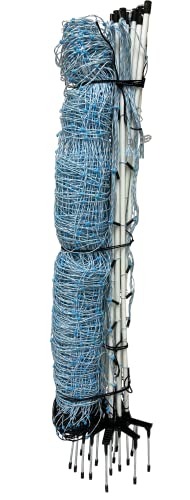
Starkline all-purpose electric netting, 42 in x 82 ft
Shorter run and lower cost, for a small paddock or a first section before you commit to a full boundary.
Same rules apply: it teaches an animal rather than holding one, and an unpowered netting fence is not a fence.
Check price on Amazon
Common questions
What kind of fence works best for goats?
Woven wire made for sheep and goats is the usual answer for a permanent fence, because the mesh spacing is tight enough that a goat cannot push a head through. Electric works too, and extension guidance for small ruminants calls for three to five strands with the lowest wire close to the ground. Most people end up with woven wire on the boundary and electric where they move animals around.
Is welded wire fence good for goats?
Usually not. Welded wire is joined at every crossing, and those welds break when something leans on them. Goats lean, rub and climb constantly. Woven wire is wrapped rather than welded, so it flexes and springs back instead of popping apart. Welded wire is fine for a garden. It is a poor choice for animals that treat a fence as furniture.
How many strands does an electric fence need for goats?
Extension guidance for small ruminants calls for three strands at minimum, and prefers three to five, with the lowest wire close to the ground. The low wire matters because a goat's first move is under, not over. Alabama Extension notes small ruminants need multiple strands of polywire reaching close to the ground.
How high does a goat fence need to be?
It depends on what you are keeping in and what you are keeping out, and published heights vary for that reason. For predator protection specifically, eXtension describes night pens built with 6 to 8 foot fencing using 4 by 4 woven wire. For ordinary containment, most goat producers work lower than that. Ask your extension office what the predators in your county actually require.
Why do goats get their heads stuck in fences?
Because the mesh is the wrong size. A horned goat can push its head through a square, then cannot pull it back because the horns catch. Sheep and goat woven wire uses tighter spacing to stop this. Cattle panel and large-square field fence are common culprits, and it is not a small problem: a stuck goat in summer sun is in real trouble.
Will a fence keep predators away from goats?
It helps and it does not settle the matter. Fencing is one layer. eXtension covers guardian animals, night penning and husbandry alongside fencing for a reason. Treat a fence as something that raises the effort required, not as a wall.
Next
Energizers and Grounding
Sizing, ground rods, and why manufacturer mileage ratings differ by twelve times.
Goat Shelter
Dry beats warm, and why published space figures disagree.
Electric Poultry Netting
The same electric principles, applied to birds.
Hardware Cloth
Mesh, burial depth and the apron, for keeping things out rather than in.
Sources: Penn State Extension, meat goat fencing, eXtension Goats on predator control (archived copy), UGA Extension, Fences for the Farm, and Alabama Extension on temporary electric fencing.
Before you choose: Goat fence height
Before choosing materials, work out what height and stay spacing your system actually needs. The style number on a roll of woven wire tells you both.
Read goat fence height