
Energizer Sizing and Grounding
Disclosure: we may earn a commission when you buy through some links on this page, at no extra cost to you. It does not affect what we recommend or how we rank it. How this works.
Most electric fence problems are not the energizer. They are the ground. That is worth knowing before you buy a bigger box.
The short version
- Ignore the mileage on the box. Makers disagree about it by twelve times.
- About 3 feet of ground rod per joule. This is the figure sources agree on.
- Rods about 10 feet apart, driven 6 to 8 feet, in the dampest ground you have.
- Add 25 percent to your fence length for grass touching the wire.
- Buy a tester. These fences fail silently.
Why nobody can tell you how many joules you need
We went looking for a number to put here. There is not one, and the reason is more useful than a number would have been.
| Source | Miles of fence per joule |
|---|---|
| One major fence company | 0.5 |
| Extension experience, most situations | 1 |
| Another manufacturer | up to 6 |
Those are all reported by Michigan State Extension, and they span a factor of twelve. No safety margin you would sensibly add covers a gap that size.
So the honest instruction is this. Use the sizing table published by whoever made the energizer you are buying, because their rating and their table were written together. A number we invented by averaging three sources that disagree would look more helpful and be worth less.
Then add 25 percent to your fence length before you look it up. Michigan State gives that as the allowance for power drained by vegetation touching the wire, and multi-wire fences carry more of it on the low wires sitting in grass.
Grounding, which is where the agreement is
An electric fence is only half a circuit. The animal is the switch, and the soil is the return path. Current leaves the wire, goes through the animal, into the ground, and travels back to the energizer through your ground rods.
Undersize that return and nothing else you do matters. The fence will read fine on a tester at the energizer and still feel like nothing to an animal standing on dry dirt.
The rule
About 3 feet of ground rod for every joule of output. A 15 joule energizer wants at least 45 feet of rod.
Rods spaced about 10 feet apart. Michigan State also describes systems using three 8 foot rods, and notes the wetter the ground the better a rod performs. Put them in the dampest ground on the property, not the most convenient.
This is why an electric fence that held stock in May stops working in August. Nothing broke. The soil dried out.
AC, solar or battery
Your power source does not change how many joules the fence needs. It only changes where they come from, and what happens when you are not watching.
| Type | Best for | Watch out for |
|---|---|---|
| AC plug-in | Anywhere with power at the fence | Needs a dry, protected spot and an outlet |
| Solar | Paddocks with no power | Lower output for the money; short winter days |
| Battery | Temporary and rotational fencing | Goes flat quietly, and nothing tells you |
Energizer, ground and tester
Mileage ratings on energizers are manufacturer claims and they are not comparable between brands. Size from your maker's own table.

Gallagher 3-rod electric fence grounding kit
Grounding is the figure sources actually agree on, at roughly 3 feet of rod per joule, and it is the part most fences are short of.
Three rods is a starting point, not a rule. Work out your own rod length from your energizer's joule rating.
Check price on Amazon
Digital fence tester and fault finder
Electric fences fail silently. Livestock find out before you do, and once they learn a wire is dead they stop respecting it.
Test at the far end of the run, not at the energizer. The energizer nearly always reads fine.
Check price on Amazon
Zareba AC-powered low impedance charger
Mains power is the cheapest way to buy joules and it never runs flat.
Size it from Zareba's own table. Mileage ratings are not comparable between brands.
Check price on Amazon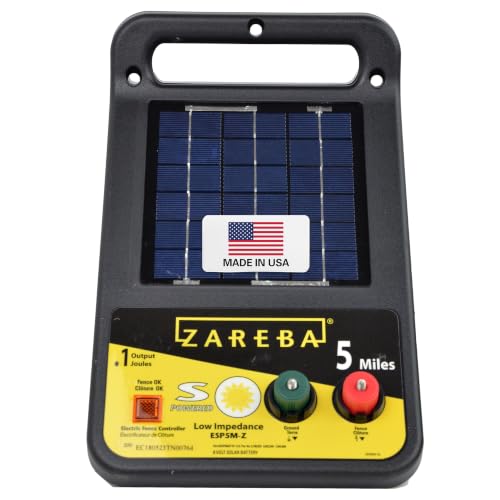
Zareba solar low impedance charger
For a paddock with no power at the fence line.
Solar buys fewer joules per dollar and winter days are short. Size from the maker's table.
Check price on Amazon
Safety, and where this page stops
- Follow the installation instructions that came with your energizer. They are specific to that unit, and they override anything general written here.
- Never connect an electric fence to barbed wire. An animal that gets caught on barbs cannot pull away from the shock.
- Keep the fence ground system well away from a building’s electrical ground. Your energizer instructions state the distance.
- Warning signs are required in many places where a fence borders a road or public path. Check your local rules.
- Mains wiring is an electrician’s job, not this page’s.
Common questions
How many joules do I need for my electric fence?
There is no single answer, and the spread between sources is the reason. Michigan State Extension reports one fence company sizing on half a mile of fence per joule while another suggests up to six miles per joule, and extension experience often lands near one mile per joule. That is a twelvefold range for the same question. Use the sizing table from the maker of the energizer you are buying, and treat the mileage number on the box as a marketing figure rather than a measurement.
How many ground rods does an electric fence need?
The rule that does not vary much between sources is about 3 feet of ground rod for every joule of output. A 15 joule energizer therefore wants a minimum of 45 feet of rod. Rods are commonly driven 6 to 8 feet and spaced about 10 feet apart, and wetter soil grounds better than dry.
Why does an electric fence stop working in dry weather?
Because the circuit runs through the soil. An animal touching the wire completes a path from the fence, through the animal, into the ground, and back to the energizer through your ground rods. Dry soil conducts poorly, so the same fence that worked in spring can feel like nothing in August. That is a grounding problem, not an energizer problem, and adding rods usually fixes it.
Should I get a solar, AC or battery fence charger?
AC if there is power at the fence line, because it is the cheapest per joule and never runs flat. Solar for a paddock with no power, accepting that output is usually lower and winter is harder on it. Battery for temporary work. The important part is that your choice does not change how many joules the fence needs, only where the joules come from.
How much does vegetation touching the fence matter?
Enough to size for. Michigan State Extension gives a rule of thumb of adding 25 percent to your calculated fence length to cover power drained by vegetation. Multi-wire systems carry more of that load on the lower wires, which are the ones sitting in grass.
How do I know my electric fence is actually working?
Test it with a fence tester rather than by touching it or watching the animals. A fault finder shows voltage and points you toward where it is being lost. Electric fences fail silently, and livestock generally learn a wire is dead before the owner does.
Next
Sources: Michigan State Extension on selecting and installing a charger, Michigan State Extension on grounding, and Penn State Extension, choosing an energizer. Your energizer’s own manual outranks all of them for that unit.
Before you choose: Goat fence height
An energizer is sized to a fence. Settle the fence system first, including how many strands are live.
Read goat fence height