
Poultry Guide
Electric Poultry Netting: Energizer Sizing, Grounding, and What It Will Not Stop
Disclosure: we may earn a commission when you buy through some links on this page, at no extra cost to you. It does not affect what we recommend or how we rank it. How this works.
Sizing the energizer and grounding it are the same job on any electric fence: see the energizer and grounding guide, which covers why manufacturer mileage ratings differ by twelve times.
Netting is the outer layer. For the coop itself, mesh size and the buried apron are what exclude a digging predator: see the hardware cloth guide.
Electric netting does two jobs well. It keeps birds where you put them, and it teaches ground predators to go somewhere else.
It does a third job badly, and that is the one people buy it for. This guide covers energizer sizing, the grounding half nobody does properly, why fences die in July, and the predators netting has no answer for.
Last updated: August 31, 2026 · Sourced from Alabama Cooperative Extension and eXtension Poultry
Netting Is Not a Predator-Proof Barrier
An electric fence works on memory. An animal touches it, learns, and avoids it afterwards. That is genuinely effective against a raccoon or a fox exploring your treeline, and it is nothing at all against a hawk, a determined digger, or any animal on the far side of a fence that has quietly stopped working.
eXtension Poultry does not treat any enclosure as sufficient on its own: “such enclosures may not be sufficient to protect the flock, and additional peripheral fencing may be needed”. (eXtension Poultry)
The night rule does not change. Its standing recommendation is to “Have the flock roost inside a secured location at night, making sure to close and lock all doors.” Netting is a daytime tool. The coop door is what keeps birds alive overnight.
What It Is Genuinely Good At
- Containment. Birds learn the boundary quickly and stay inside it, which keeps them out of the garden and off the road.
- Rotation. A net that moves is what makes pastured poultry work. Fresh ground every week or two, no permanent bare patch.
- Daytime deterrence. Ground predators that touch it tend not to come back, which is real protection during the hours birds are out.
- Speed. A net goes up in under an hour and leaves nothing behind when it moves.
None of that is small. The mistake is not buying netting. It is retiring the locked coop because you bought netting.
Energizer Sizing, and the Trap in the Rating
Energizers are sold on joules, miles, or acres. Alabama Extension notes they are “typically labeled with the joules of power, the miles of fence, or the acres covered”, and then supplies the detail that makes the mileage figure misleading for netting:
“Miles of fence are calculated by multiplying the number of strands × the length of fence (total length of all energized wire), not simply the linear distance.” (Alabama Extension)
A single 164-foot poultry net carries roughly nine conductive horizontal strands. That is on the order of 1,500 feet of energized wire from one net, before you add a second. The linear number on the box is not the number that matters.
Read the output joules rather than stored joules. Listings frequently quote both, and they are not the same figure. Grounding is specified per joule of output, so the distinction changes what you need to install.
Grounding: The Half of the Circuit People Skip
A fence shock is a completed circuit through the animal and back through the soil. If the earth side is inadequate, the animal feels very little, no matter what the energizer cost.
Alabama Extension gives the rule: “the system requires a minimum of 3 feet of ground rod for every joule of power”, with rods “at least 10 feet apart and connected to the system using an insulated wire”.
| Energizer output | Minimum ground rod | Typical arrangement |
|---|---|---|
| 0.5 joule | 1.5 feet | One short rod |
| 1 joule | 3 feet | One rod |
| 2 joules | 6 feet | Two rods, 10 ft apart |
| 6 joules | 18 feet | Three rods, 10 ft apart |
Dry, sandy or frozen ground conducts poorly, so the same installation performs differently in August than in May. If voltage drops in a dry spell and the fence line is clear, the ground side is the place to look.
Vegetation Is Why Fences Die in July
Netting sits close to the ground along its entire length, which is exactly where grass grows. Every blade touching a live strand is a small leak to earth, and hundreds of them together are a short circuit.
Alabama Extension lists the factors that decrease fence voltage, and the first is “Weedy or overgrown fence lines, especially thick brush or green grass with plenty of moisture”. Green and wet is worse than dry and brown, which is why a fence that held all spring fails after a wet week.
The practical answer is not a bigger energizer. It is moving the net before the vegetation reaches the lower strands, and clearing the line where it sits. A net that is moved on schedule mostly manages its own vegetation load, because the birds do it.
What Netting Has No Answer For
| Threat | Netting helps? | What actually addresses it |
|---|---|---|
| Fox, coyote, dog, raccoon by day | Yes | A hot, well grounded, clear fence line |
| Hawks and owls | No | A covered run; extension suggests orange netting overhead |
| Digging under | Barely | Buried hardware cloth, at least 12 inches, on a fixed run |
| Anything at night | No | Birds shut in a locked coop |
| Weasels, rats, snakes | No | Hardware cloth on the coop, small mesh |
| A fence that has shorted out | No | A voltage tester and a routine of using it |
The last row is the one that catches people. A shorted net looks identical to a working one. Nothing about it announces that it stopped being a fence, and the first evidence is usually a loss.
The Three Parts of a Working Net
A net on its own is fence-shaped plastic. It needs something to energise it and something to prove it is still energised.
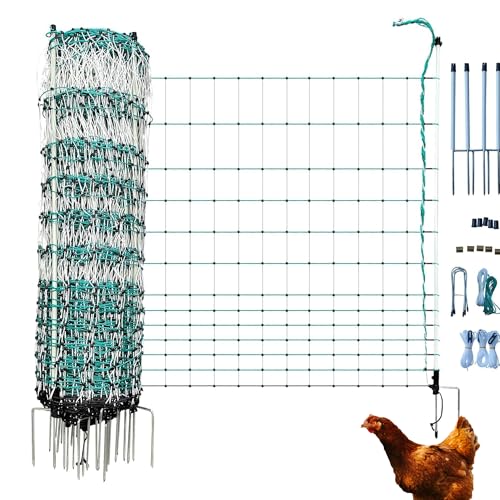
Poultry netting, 48 inch by 168 foot
Pre-attached posts every 12 feet, so one person can move it and re-set it on fresh ground without tools.
Roughly 1,500 feet of energized wire once you count the horizontal strands, not 168. Size the energizer against that figure, not the linear length.
Check price on Amazon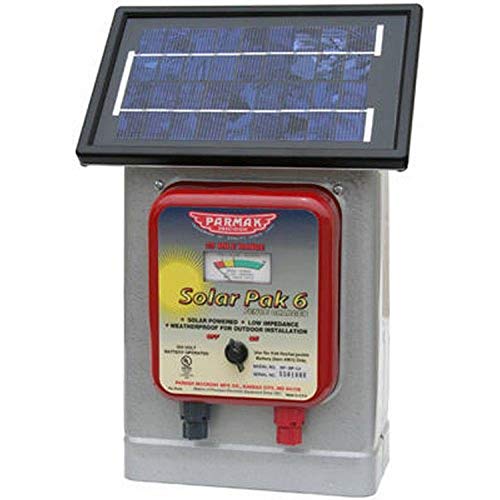
Solar fence energizer
Runs the net where there is no mains power, which is most of the places a portable net is useful.
Read output joules, not stored joules. Grounding is specified per joule of OUTPUT, at three feet of rod per joule.
Check price on Amazon
Digital fence voltage tester
A shorted net looks exactly like a working one, and the usual first evidence is a dead bird. This is the only way to know the fence is still a fence.
Test at the far end from the energizer, not at the terminals. A reading at the box tells you the energizer works, not that the net is live.
Check price on Amazon
Common Mistakes
- Retiring the locked coop. Netting is a daytime tool. Night is a door and a latch.
- Sizing the energizer off linear feet. Multiply by the strands. One net is far more wire than it looks.
- One short ground rod. Three feet per joule of output, rods ten feet apart.
- Letting grass reach the bottom strand. Green wet growth is the fastest way to a dead fence.
- Never testing. A shorted net looks exactly like a working one.
- Reading stored joules as output joules. The grounding requirement follows output.
- Expecting it to stop a hawk. Nothing on the ground addresses an aerial predator.
Common questions
Does electric poultry netting keep predators out?
It discourages ground predators. It does not exclude them. eXtension Poultry is clear that enclosures may not be sufficient to protect the flock and that additional peripheral fencing may be needed, and it still recommends having the flock roost inside a secured location at night with doors closed and locked. Netting is a daytime tool, not a replacement for a locked coop.
What size energizer do I need for poultry netting?
More than the net's length suggests. Alabama Extension notes that miles of fence are calculated by multiplying the number of strands by the length of fence, not the linear distance. A 164-foot net with nine conductive strands is close to 1,500 feet of energized wire, so rate the energizer against that figure and against the vegetation it will be fighting.
How much grounding does an electric fence need?
Alabama Extension gives the rule of thumb as a minimum of 3 feet of ground rod for every joule of power, with rods at least 10 feet apart connected using insulated wire. Grounding is the half of the circuit people skip, and an under-grounded fence delivers a weak shock no matter how good the energizer is.
Why does my fence lose power in summer?
Vegetation. Alabama Extension lists weedy or overgrown fence lines, especially thick brush or green grass with plenty of moisture, among the factors that decrease voltage on a fence. Netting sits close to the ground along its whole length, so it collects vegetation load faster than a wire fence does.
Will netting stop a hawk?
No. Nothing about an electric fence addresses an aerial predator. For a persistent hawk or owl, eXtension Poultry recommends a covered run, and notes orange netting is best because hawks and owls see orange well.
Can a predator dig under electric netting?
Yes, and portable netting is harder to protect against digging than a permanent run, because you cannot bury it. For a fixed pen, eXtension Poultry recommends burying hardware cloth at least 12 inches into the ground to deter diggers. Portable netting trades that protection for the ability to move.
How often does netting need moving?
Move it when the birds have taken the vegetation down but before they take it to bare ground. That timing serves two purposes at once: the pasture recovers, and moving the net onto fresh ground is also what keeps vegetation off the lower strands.
Is electric netting safe around children and pets?
A fence energizer intended for this use is designed to deliver a short, sharp pulse rather than a continuous current. eXtension Poultry frames the requirement as the amount of electricity being enough to stun but not kill an animal. Site it where visitors will not walk into it, and use the warning signage your energizer supplies.