
Root Cellar Storage
Disclosure: we may earn a commission when you buy through some links on this page, at no extra cost to you. It does not affect what we recommend or how we rank it. How this works.
A root cellar is not one set of conditions. Extension guidance describes two, and putting the wrong crops together in one of them is how a good harvest turns into a bad winter.
The short version
- Cold and very damp: 32–40°F, 90–95% humidity.
- Cold and damp:32–40°F, 80–90% humidity.
- Keep apples away from potatoes. Ethylene from fruit makes potatoes sprout.
- More produce needs more air. Ventilation clears carbon dioxide and ethylene.
- Measure both numbers. The method is temperature and humidity, so guessing is not doing it.
Two conditions, not one
People treat a root cellar as a single cold room. Extension guidance splits it, and the split is about humidity rather than temperature.
| Condition | Temperature | Humidity |
|---|---|---|
| Cold and very damp | 32 to 40°F | 90 to 95% |
| Cold and damp | 32 to 40°F | 80 to 90% |
| Potatoes specifically | 32 to 40°F | 95%, and dark |
| Apples specifically | 30 to 32°F | about 90% |
Notice that the temperatures overlap almost entirely and the humidity does not. Humidity is the variable that separates crops, and it is also the one most people never measure.
The apple problem
Apples release ethylene gas as they sit. Ethylene is a ripening signal, and in a closed cellar it reaches everything else you stored.
MSU Extension puts it plainly: potatoes should not be stored with onions, apples or other fruit, because the ethylene they produce promotes sprouting. And potatoes are not the only casualty.
What ethylene does to the rest of the cellar
- Green vegetables turn yellow
- Lettuce develops rust-coloured spots
- Asparagus spears toughen
- Carrots turn bitter
- Potatoes sprout
This is the most common root cellar failure and it does not look like a failure while it is happening. The apples are fine. Everything else quietly gets worse.
Ventilation scales with what you put in
Stored produce is still alive and still respiring. It gives off carbon dioxide and, from fruit, ethylene. Extension guidance is that the greater the density or amount of produce in the space, the more ventilation is needed.
For a large quantity, the suggested answer is structural rather than mechanical: add a central partition so there are two storage areas, ideally each with its own ventilation. That solves the apple problem and the air problem in one move, which is why it is worth doing when you build rather than retrofitting later.
Cellar, or a corner of a basement
A modern basement with heating in it is usually too warm and much too dry. That does not rule it out, it just means the room as a whole is not the storage.
What works is partitioning a corner against an outside wall, as far from the furnace as the layout allows, and giving it a vent to outside. The name of the room is not the test. Whether you can hold 32 to 40°F at the humidity your crops need is the test, and that is answerable only by measuring.
What goes in matters as much as where
A cellar holds condition. It does not improve it. Produce that went in bruised, cut or wet keeps badly however good the conditions are, and one rotting item takes its neighbours with it.
Sort before storing, keep crops in slatted crates or bins that let air move rather than sealed containers, and walk the cellar through the season. We are not going to publish shelf-life figures per crop, because the honest answer depends on the crop's condition going in and how steady you hold the room. Checking beats a table.
The gauge that makes the method work
The whole approach is two numbers. Without measuring them you are guessing at both.
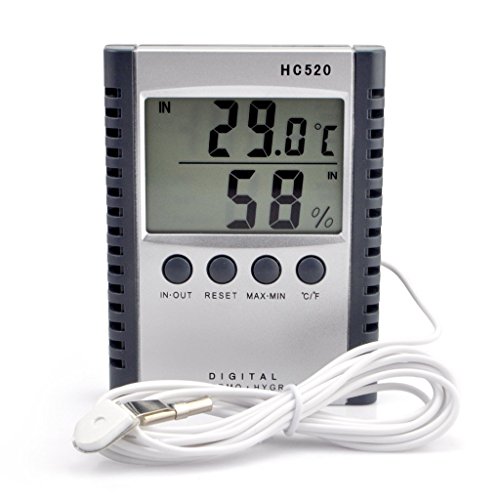
Digital thermometer and hygrometer
The whole method is 32 to 40 degrees at a stated humidity. Without measuring both you are guessing at both.
Humidity is the number that separates crops, and it is the one almost nobody checks.
Check price on Amazon
Where this page stops
Storage conditions for fresh produce. This is not canning, freezing or drying, and it is not a food-safety authority. Cellar storage keeps fresh crops fresh for a season; it does not preserve them. For preserving, the pressure canning and dehydrating guides cover methods with tested procedures behind them. If produce is questionable, throw it out rather than looking for a rule that lets you keep it.
Common questions
What temperature and humidity does a root cellar need?
Extension guidance splits this into two conditions rather than one. Cold and very damp is 32 to 40°F at 90 to 95 percent relative humidity. Cold and damp is 32 to 40°F at 80 to 90 percent. Potatoes want the damper end, around 32 to 40°F and 95 percent humidity, in the dark. Apples store at 30 to 32°F and about 90 percent.
Why can't you store apples and potatoes together?
Apples give off ethylene gas, and ethylene makes potatoes sprout. MSU Extension is direct about it: potatoes should not be stored with onions, apples or other fruit for that reason. Ethylene also yellows green vegetables, puts rust-coloured spots on lettuce, toughens asparagus and turns carrots bitter.
Does a root cellar need ventilation?
Yes, and the more produce you store the more you need. Ventilation manages carbon dioxide and ethylene, which both build up in a sealed space. Extension guidance suggests that for a large quantity it is worth adding a central partition to make two storage areas, each with its own ventilation.
Can I use my basement as a root cellar?
Part of one, sometimes. A modern heated basement is usually too warm and far too dry for the conditions above. What people do is partition off a corner against an outside wall, away from the furnace, and add a vent. The test is not what the room is called, it is whether you can hold the temperature and humidity a crop needs.
How long will vegetables keep in a root cellar?
That depends on the crop, its condition going in, and how steady you hold the conditions, so any single figure would be misleading. What is reliable is the direction: produce that went in damaged or wet keeps badly no matter how good the cellar is. Sort before storing and check through the season rather than trusting a stated shelf life.
Do I need a thermometer and hygrometer in a root cellar?
The whole method is two numbers, so yes. Without measuring you are guessing at both, and the gap between 80 and 95 percent humidity is the difference between crops that shrivel and crops that hold. A cheap combined gauge tells you whether your cellar is doing what you think it is.
Next
Sources: MSU Extension, home storage of fruits and vegetables, MSU Extension on storage conditions, and UMN Extension, harvesting and storing.
Before you choose: Root cellar temperature and humidity
Cold and moist is 32 to 40 degrees at 95 percent humidity. Knowing which condition you are building for decides nearly every other choice.
Read root cellar temperature and humidity