
Buyer's Guide
Best Food Dehydrators (2026), Excalibur vs Cosori vs Nesco
Disclosure: we may earn a commission when you buy through some links on this page, at no extra cost to you. It does not affect what we recommend or how we rank it. How this works.
A food dehydrator is the most practical food preservation tool on a homestead. It is cheaper than a freeze dryer, quieter than a canner, and works on everything from garden herbs to beef jerky. The real question is not whether to buy one, it is which airflow design fits your workflow.
Last updated: October 6, 2026· Based on community data from r/homesteading, r/jerky, and homesteading forums
The Number One Beginner Mistake
Buying a $25-$30 dehydrator and wondering why the jerky does not taste right. The budget models at that price range are underpowered (under 200W), hit inconsistent temperatures, and produce chewy, uneven results. They are not dehydrators, they are food-sitting-in- warm-air machines.
- Minimum 300W for vegetables and fruit
- 400W+ recommended for jerky and meat
- 600W is the sweet spot for serious homestead use (Excalibur, Cosori, Nesco all hit 600W)
- Dial thermostats on cheap models are notoriously inaccurate, so a machine set to 140°F may sit well below it, which matters for drying time and for how long the meat stays in the range where spoilage organisms are comfortable
Making Jerky Safely: Heat First, Then Dry
This is the one instruction on this page worth reading twice, because the common advice has the order backwards.
- Heat the meat first. USDA FSIS recommends bringing meat to an internal 160°F, and poultry to 165°F, before it goes into the dehydrator.
- Then dry it. Maintain a constant 130°F to 140°F through the drying process.
Why the order matters. Inside a dehydrator, the evaporating moisture absorbs most of the heat, so the meat itself barely warms until most of the water has already gone. By the time it does warm up, any surviving bacteria have become more heat resistant. A kill step applied at the end lands on the hardiest survivors under the worst conditions. Applied first, by wet heat, it lands on them while they are still vulnerable. (USDA FSIS, Jerky and Food Safety)
Quick Picks
- Best overall (gold standard): Excalibur 3926TB , horizontal airflow, 15 sq ft, no tray rotation needed
- Best value (daily driver): Cosori Pro II , digital, quiet, stainless trays, easy cleanup
- Best budget (expandable): Nesco Snackmaster Pro , expandable to 12 trays, made in USA, under $70
- Biggest single batch: Excalibur 3926TB , 9 trays, 15 sq ft total, the only real answer for bulk processing
Horizontal vs Vertical Airflow, This Is the Most Important Decision
Every food dehydrator uses one of two airflow designs. This choice affects drying consistency more than wattage, tray count, or price.
| Feature | Horizontal (rear fan) | Vertical (top or bottom fan) |
|---|---|---|
| Fan Direction | Blows across all trays simultaneously | Blows up or down through tray stack |
| Tray Rotation | Not needed | Required for even results |
| Drying Consistency | Very even, top and bottom finish at same time | Uneven without rotation, top trays dry faster |
| Flavor Transfer | Minimal, each tray is independent | Can transfer between trays (garlic next to apples is a problem) |
| Price Range | $250–$600+ | $50–$180 |
| Best Example | Excalibur 3926TB | Nesco FD-75A, Cosori Pro II |
Bottom line: If you are serious about jerky and large batches, pay for horizontal airflow. For casual use, herbs, fruit, occasional jerky, vertical is fine if you rotate trays once during the cycle.
Our Top Picks

Cosori Food Dehydrator, 6 Stainless Steel Trays
Cosori
$100 to $200
6 stainless steel trays, digital temperature control from 95-165°F, and an adjustable timer. The quietest and most beginner-friendly all-around dehydrator on the market.
+Very quiet operation — won't drive you out of the kitchen
+Digital timer and temperature control are easy to use
-Not expandable — 6 trays is all you get
-Smaller total drying area than Excalibur
The Cosori Pro II is the practical pick for most homesteaders. It is quiet, easy to use, and produces excellent results on everything from fruit leather to beef jerky. The stainless steel trays are a meaningful upgrade over plastic. If you want a set-it-and-forget-it dehydrator without spending Excalibur money, this is your machine.

Nesco Snackmaster Pro FD-75A
Nesco
$50 to $100
5 trays expandable to 12. 600 watts. The best budget dehydrator made in the USA. Vertical airflow means occasional tray rotation, but the price is hard to argue with.
+Under $70 — best price entry point
+Expandable from 5 to 12 trays as your needs grow
-Vertical airflow requires rotating trays mid-cycle
-No timer on base model
The Nesco FD-75A is where most homesteaders start their dehydrating journey. At $70, you can try the hobby without a real commitment. The expandable design lets you grow with it. The only real frustration is the vertical airflow requiring tray rotation. At this price, that is a fair trade. If you outgrow it, step up to the Excalibur.

Magic Mill Food Dehydrator
Magic Mill
$100 to $200
7 stainless steel trays, adjustable thermostat, 400W. BPA-free, solid mid-range build quality at a price between budget and premium.
+Stainless steel trays at a mid-range price point
+BPA-free throughout
-Less established brand with shorter reliability track record
-400W is sufficient for fruit and veg but underpowered for large jerky batches
The Magic Mill is the middle-ground pick for homesteaders who want stainless steel trays without paying Excalibur prices. The build quality is good and the BPA-free materials are a genuine bonus. The 400W motor handles herbs, fruit, and vegetables well. For heavy jerky batches, step up to the 600W Cosori or Excalibur.
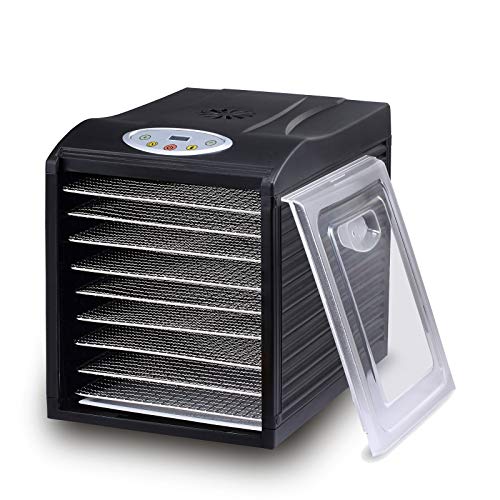
BioChef Arizona Sol Food Dehydrator
BioChef
$100 to $200
6 trays with a clear door — monitor your batch without opening the machine. Digital timer and thermostat. A good beginner-friendly design choice.
+Clear door lets you check progress without opening and losing heat
+Digital timer and thermostat are easy to set
-Smaller brand with limited US support resources
-6 trays limits batch size
The BioChef Arizona Sol earns its spot because the clear door is a genuine quality-of-life feature that most dehydrators skip. Being able to check your batch without opening the machine and disrupting the temperature is more useful than it sounds. A solid option for beginners who want a clean, modern design.
What Homesteaders Dehydrate Most
Meat & Jerky
Beef, venison, turkey, and salmon jerky. Heat the meat to 160°F, or 165°F for poultry, BEFORE it goes in, then dry at 130°F to 140°F. Horizontal airflow (Excalibur) produces more consistent results across a full batch.
Garden Herbs
Basil, oregano, thyme, rosemary, dry at 95-115°F. This is where any dehydrator shines. Even the Nesco FD-75A produces excellent dried herbs.
Fruit & Fruit Leather
Apples, peaches, berries at 135°F. Fruit leather is a crowd favorite, blend fruit, pour on a solid sheet insert, dry 6-8 hours.
Vegetables for Storage
Tomatoes, onions, peppers, zucchini at 125-135°F. Rehydrate in soups and stews. A full garden harvest can become a year of shelf-stable vegetables.
When Dehydrating Is Not Enough
Dehydrated food lasts 1-3 years with good storage. Freeze-dried food lasts 20-25 years. If long-term emergency preparedness or large-scale food storage is your goal, a freeze dryer is the upgrade.
Read our freeze dryer buyer's guide →Supplies you will buy again

Mesh screens and fruit leather sheets
Small things like herbs fall through the trays. Mesh holds them. The solid sheets are what you need for fruit leather.
Measure your trays before you order. Sheet sizes are not the same across brands.
Check price on Amazon
Mylar bags with oxygen absorbers
Dehydrated food loses its shelf life to air and light faster than most people expect, and this is what stops that.
Dehydrated food keeps residual moisture, so it will not match freeze dried shelf life however well it is sealed.
Check price on Amazon
Gamma seal lid
Turns a standard bucket into airtight, hand-openable storage for the sealed bags.
Fits standard food-grade buckets. Check your bucket diameter before ordering.
Check price on Amazon
Common questions
What is the best food dehydrator for jerky?
The Excalibur 3926TB is the best for jerky. Its horizontal airflow dries all trays evenly without rotation, and 15 square feet of space lets you run large batches. The Cosori Pro II is a strong second for smaller batches. On safety, note that USDA FSIS recommends heating meat to 160°F, and poultry to 165°F, BEFORE it goes in the dehydrator, then drying at a constant 130°F to 140°F. The kill step comes first, not last.
How long does it take to dehydrate food?
It depends on the food and temperature. Beef jerky: roughly 4 to 8 hours at 130°F to 140°F, after the meat has already been heated to 160°F as USDA FSIS recommends. Fruit slices: 6-12 hours at 135°F. Herbs: 1-4 hours at 95-115°F. Vegetables: 6-12 hours at 125-135°F. Thinner slices and lower moisture content always dry faster.
Excalibur vs Cosori, which is better?
Excalibur wins on capacity and airflow quality. The horizontal rear fan means every tray dries at the same rate, no rotation needed. Cosori wins on price, size, and convenience. If you run large batches regularly, get the Excalibur. If you want a quiet, compact daily-use machine, get the Cosori.
Can you dehydrate food without a machine?
Yes. You can dehydrate in a standard oven set to its lowest temperature (170-200°F) with the door cracked open. It uses more energy, takes longer, and produces less consistent results than a dedicated dehydrator, but it works for occasional use. A solar dehydrator also works in dry, sunny climates.
What temperature kills bacteria when dehydrating meat?
Heat the meat first, then dry it. USDA FSIS recommends heating meat to an internal 160°F, and poultry to 165°F, BEFORE dehydrating, then maintaining a constant 130°F to 140°F during drying. The order matters more than the numbers. Inside a dehydrator the evaporating moisture absorbs most of the heat, so the meat does not begin to warm until most of the water has gone, and by then any surviving bacteria have become more heat resistant. A kill step applied at the end is applied to the hardiest survivors. Doing it first, by wet heat, is what makes it reliable.
Affiliate Disclosure: Some links on this page are affiliate links. If you buy through them, we earn a small commission at no extra cost to you. This supports the site and keeps our reviews independent. Full disclosure.
Models people still search for, that you cannot currently buy
These are kept because owners still look them up. They are not ranked above, and they are not a current recommendation.
- Excalibur 3926TB Food Dehydrator. Not discontinued, out of stock. Excalibur's own store still lists the 3926TB and shows it sold out, checked 2026-08-30. Amazon carries Excalibur 6, 8 and 10-tray models but not this 9-tray. Kept because owners search the model number, and no near-match is substituted for it.