
Beekeeping Equipment Guide
Honey Extractor: Manual or Electric, and How Many Frames You Actually Need
Disclosure: we may earn a commission when you buy through some links on this page, at no extra cost to you. It does not affect what we recommend or how we rank it. How this works.
Nearly every extractor comparison is a comparison of motors. The motor is rarely the thing that decides your harvest day.
What decides it is how many hives you run, what depth your frames are, and how fast you can uncap. This guide works through those in order, then covers the equipment that has to exist on either side of the extractor before a jar of honey comes out the end.
Last updated: August 31, 2026 · Sourced from University of Georgia Extension, with hands-on observations credited to Jason Chrisman Bees
The Short Answer
- 1 to 2 hives: crush and strain, or borrow a club extractor.
- 3 to 8 hives: a manual extractor, and spend the difference on basket size rather than a motor.
- 8 or more hives: electric starts paying for itself, mostly in the hours you are not standing there.
- Whatever you buy: check the basket takes your frame depth, and budget for uncapping and straining too.
What an Extractor Actually Does
University of Georgia Extension describes the machine plainly. It is “a drum containing a rotating wire basket”. Uncapped combs go in the basket, the basket is “turned by hand or by motor”, and honey is “flung out of the combs onto the sides of the tank and drains through a spigot”. (UGA Extension B1045)
The important word in that description is uncapped. Everything an extractor does depends on work you have already done by hand, which is why the machine is almost never the bottleneck.
Why an Extractor Beats Crush and Strain
Crushing comb and straining the honey out works, costs nothing, and is a perfectly reasonable way to harvest one or two hives. It has one real cost, and it is not the mess.
Crushing destroys the drawn comb. An extractor returns it intact, so it goes straight back on the hive. Comb the bees do not have to rebuild is comb they can fill immediately, and that is worth more to next season than the afternoon the machine saved you. That is the actual argument for owning one.
Manual and Electric, Compared Honestly
Jason Chrisman Bees put a four-frame hand crank model and an eight-frame electric model side by side on camera and worked through the differences. Several of his observations are the kind you only get from assembling both, and they are worth repeating because they do not appear on any spec sheet.
| Hand crank | Electric | |
|---|---|---|
| Drive | Often direct to the basket | Motor through a coupling |
| Parts that wear | Fewer | Coupling, switch, motor |
| Lids | Often loose, sit on prongs | Often hinged, sometimes magnetic |
| Stopping to load frames | Wait for it to slow, or stop it by hand | Lid switch can cut the motor |
| Speed control | Your arm, which is an advantage | A dial, easy to overdo |
| Needs bolting down | Yes | Yes |
Two of those rows deserve expanding, because they cut against the assumption that electric is simply the better machine.
A hand crank has fewer things to fail. On the electric unit he examined, the motor drives the basket through a flexible coupling, a wearing part that gets stocked as a spare. The hand crank model was bolted straight to the gearbox with nothing in between. Fewer parts in the drive is a real durability advantage, not a consolation prize.
Your arm is a better speed controller than a dial. Comb tears when it is spun too fast, especially new comb and especially on the first side. Cranking gives you constant feedback about how hard the machine is working. A motor will happily destroy a frame at a setting that felt fine on the last one.
One detail from that comparison is worth knowing before you buy anything: on both units the honey gate sat slightly above the floor of the drum, so at the end of a run “you will have to lean the extractor to get the rest of the honey”. Plan for that. A full drum is heavy and awkward to tilt, and that is exactly when it is fullest.
The side-by-side comparison this section draws on:
Radial or Tangential
This is a description of how the frames sit in the basket, and it changes how much handling a harvest takes.
- Tangential. The comb face sits against the drum wall. Only the outer side throws its honey, so you stop, take each frame out, turn it around, and run it again. More handling, but the side facing the wall empties thoroughly.
- Radial. Frames sit like spokes on a wheel, top bar outward. Both sides empty at once, with no flipping. Far less handling, which is where the real time saving in a big harvest comes from.
Small hobby extractors are usually tangential. The flipping matters less than you would think at four frames and a great deal at twenty. If you are weighing a larger machine, radial is often the upgrade that changes the day, more than the motor is.
The Bottleneck Is Uncapping, Not Spinning
Every frame has to be uncapped by hand before it goes in the basket. UGA Extension describes the tools: a heated knife “for slicing off the cappings from combs of honey”, working over a tank where “wet cappings fall onto a screen, and honey drips through to the bottom of the tank and out a spigot”.
That is a per-frame job that does not get faster when you buy a bigger extractor. A four-frame basket that spins in a few minutes is waiting on you for far longer than it runs. This is why people who upgrade the motor first are so often disappointed: they sped up the part that was never slow.
The cappings are not waste either. They carry a lot of honey, which is what the draining screen is for, and the wax left behind is usable.
What Happens After the Spigot
The extractor is one step in a chain, and buying only the extractor leaves you holding a drum of honey with nowhere to put it. UGA Extension describes the rest: strain through “a mesh of coarse screen or cloth directly under the extractor spigot”, then let it settle in a tank, where “air bubbles and small debris rise to the top and can be skimmed off”.
Settling is the step most first-year beekeepers skip, and it is the difference between cloudy jars and clear ones. It costs nothing but a day or two of patience and a food-safe container with a gate at the bottom.
Harvest Only What Is Capped
Capping is the bees telling you the honey is finished. UGA Extension: “As nectar comes in, bees place it in cells and evaporate it to about 18 percent water content. When bees cap the honey, it is considered ripe”.
Frames with large uncapped patches usually hold more water than that, and honey stored above that range can ferment in the jar. Pulling a super early because the extractor is set up and you are ready is a real temptation and a bad trade.
The Rest of the Harvest Chain
These three cover the steps either side of the extractor that UGA Extension describes: uncapping over a screen, straining under the spigot, and settling before you bottle.

Heated uncapping knife
Uncapping is the step that actually costs you the day, and UGA Extension describes a heated knife as the tool for slicing cappings off the comb.
A cold serrated knife works for a few frames. Heat earns its place once you are uncapping a super or more at a sitting, not before.
Check price on Amazon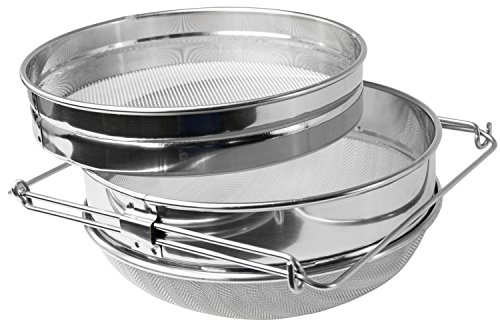
Double sieve stainless strainer
Sits under the extractor spigot to catch wax and debris on the way out, which is the straining step UGA describes before honey goes to a settling tank.
Check it fits the rim of the bucket you plan to drain into. Strainers are sized for a bucket, not for an extractor.
Check price on Amazon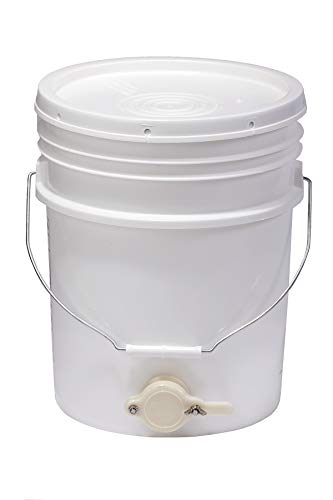
Food-grade bucket with honey gate
The settling and bottling container. Honey rests, bubbles and fine debris rise, and the gate lets you draw clear honey from below the surface.
This one is food-grade plastic. If you are selling honey or storing it long term, check whether your buyer or your state expects stainless.
Check price on Amazon
When to Upgrade
Upgrade when one of these is true, and not before:
- You are reloading the basket more than about six times. That is when capacity, not power, is costing you the day.
- You have moved to a different frame depth. A basket that will not hold your frames is not an inconvenience, it is unusable.
- Flipping frames has become the whole afternoon. That is the argument for radial.
- You are selling honey. Food-safe stainless throughout stops being optional at that point.
Common Mistakes
- Not bolting it down. A loaded basket that is even slightly out of balance walks across the floor.
- Spinning new comb hard. Fresh comb has no strength. Start slow, do a little of each side, build up.
- Buying for the motor. Basket size and frame fit matter more for most hobby beekeepers.
- Ignoring frame depth. Check the basket takes what you run before you order.
- Washing with detergent. Warm water does it. Detergent hides in seams.
- Storing it damp. Dry it completely before the lid goes on for the winter.
Common questions
How many hives before an extractor is worth buying?
Most beekeepers reach for one somewhere around three or four hives. Below that, crush and strain works and costs nothing, though it destroys the comb. The real argument for an extractor is not speed. It is that drawn comb goes back on the hive intact, and comb the bees do not have to rebuild is worth more to next year's crop than the time you saved.
Manual or electric?
Manual up to roughly six to eight hives, electric beyond that. But the honest answer is that the crank is rarely the thing that tires you out. Uncapping is. If you are choosing between a bigger manual extractor and a small electric one, the bigger basket usually helps more than the motor does.
What is the difference between radial and tangential?
It is how the frames sit. In a tangential extractor the comb faces the drum wall, so only the outer side empties and you stop and flip every frame. In a radial extractor the frames sit like spokes on a wheel and both sides empty at once, no flipping. Radial saves handling. Tangential gets more out of a stubborn frame because that side faces the wall directly.
Does frame size matter when buying an extractor?
Yes, and it is the specification people miss. A basket built for deep frames may hold a medium frame loosely, and a basket sized only for one depth will not take another at all. Check which frame depths the basket is designed to hold before you buy, because it is not something you can adapt later.
When is honey ready to extract?
When the bees have capped it. University of Georgia Extension explains that bees evaporate nectar to about 18 percent water content, and when bees cap the honey, it is considered ripe. Uncapped cells usually hold more moisture than that, which is what leads to fermentation in storage.
Do I need a stainless steel extractor?
For anything you sell or store long term, yes. Honey is acidic, so the drum has to be a food-safe material that will not react with it. Stainless is the standard for that reason. Check that the drum itself is stainless and not only the frame or the legs.
How do I clean an extractor?
Warm water and nothing else, for the most part. Honey dissolves readily in warm water, and detergent residue is far harder to rinse out of seams than honey is. Let it drain fully and dry completely before storing, because trapped moisture in a sealed drum is how you find a problem next season.
Can I borrow one instead?
Often yes, and it is worth asking before you spend anything. Many local beekeeping associations own a club extractor members can book. It also lets you handle both types before choosing, which tells you more than any specification list.
Related Guides
- Langstroth or top bar: the hive choice that decides your harvest method
- What beekeeping actually costs in year one
- All beekeeping guides
Hands-on comparison details in this guide come from “Vevor Manual Extractor VS Electric Extractor! Which one is better?” by Jason Chrisman Bees.